Kate Donovan


Last update on 2026-10-01 at 05:33 / Affiliate links / Images from Amazon Product Advertising API
Surprising fact: most yard overgrowth stops being a string-trimmer job at about 1 inch — and that’s exactly where modern tools shine.
I test these machines in real yards. I look for what they can and can’t do: cleaning outer growth, shaping walls of green, and tackling the occasional stubborn branch that’s just shy of chainsaw size.
For 2026 I’m heavy on cordless models — less noise, no gas fuss, and instant start. That doesn’t mean every battery makes the cut; run time, blade speed, and balance matter as much as raw power.
I wrote this for homeowners with shrubs, privacy hedges, foundation plantings, and anyone who’s muttered “how did this get so big?” Expect picks for best overall, best value, options for thicker branches, pole models, and a compact detail trimmer.
My promise: these are hands-on picks based on cutting capacity, blade speed, weight and balance, battery platform, and safety. If it bogs down or jams, I won’t recommend it.
Bestselling Hedge Trimmers on Amazon



Last update on 2026-10-02 at 05:39 / Affiliate links / Images from Amazon Product Advertising API
Best hedge trimmers at a glance for every yard and budget
I cut through yards big and small to see which tools actually finish the job. Below is a quick shopping snapshot so you can pick fast.
Best overall cordless performance: Husqvarna Hedge Master 320iHD60
Why it wins: Fast 3,800 cuts/min and low vibration make shaping effortless. Great for sculpting.
Skip it if: its ~12.8 lb weight and higher price matter to you.
Best value cordless pick: Worx Nitro 40V WG286
Why it wins: Dual 20V batteries give solid power at a friendly price and light ~8.2 lb weight.
Skip it if: you need muscle on thick woody stems.
Best cutting power for thick branches: EGO Power+ HT2601
Why it wins: 56V platform and 26″ bar handle up to ~1.2″ stems without bogging.
Skip it if: higher weight can tire you on long jobs.
- Also notable: Greenworks Pro 60V for slow-but-strong work, Craftsman V20 pole for tall hedges, and the Worx 20V mini for tight spots.
- Quick battery note: plan spares for long runs; noise and run-time vary across models.
How I tested these trimmers tested for real-world hedge work
I ran each tool through actual yardwork to see how they handled real cuts and awkward angles. Testing meant shaping flat tops, trimming long walls, and working overhead. I timed runs, noted jams, and felt weight shifting as I moved.
Handling and comfort at different angles
I pay close attention to rotating handles and grip design. A good handle changes the whole feel when you switch from horizontal passes to vertical faces. Balance matters—poor balance makes long walls tiring fast.
Fresh growth vs. woody stems
Soft, fresh growth cuts clean with most units. The real test is thicker branches where jamming shows up. I logged when a hedge trimmer slowed or needed reverse/jam-clearing—those moments reveal true cutting performance.
Battery run time and charge time
Run time in stop-and-go work is different from continuous lab tests. I checked whether one battery finishes a small yard and how long the battery sits on the charger. If a single pack dies mid-job, a second battery changes the day.
Noise and vibration during extended trimming
I measured how models felt after 20–30 minutes. Some cordless tools run ~67–88 dB. Lower vibration kept edges neater and control better. That difference is often why I prefer one model over another.
Cordless hedge trimmers that deliver the best balance of power and convenience</h2>
When I size up battery models, I look for the sweet spot between usable power and all-day comfort. A tool that feels calm in thick growth wins over one that only looks strong on paper.
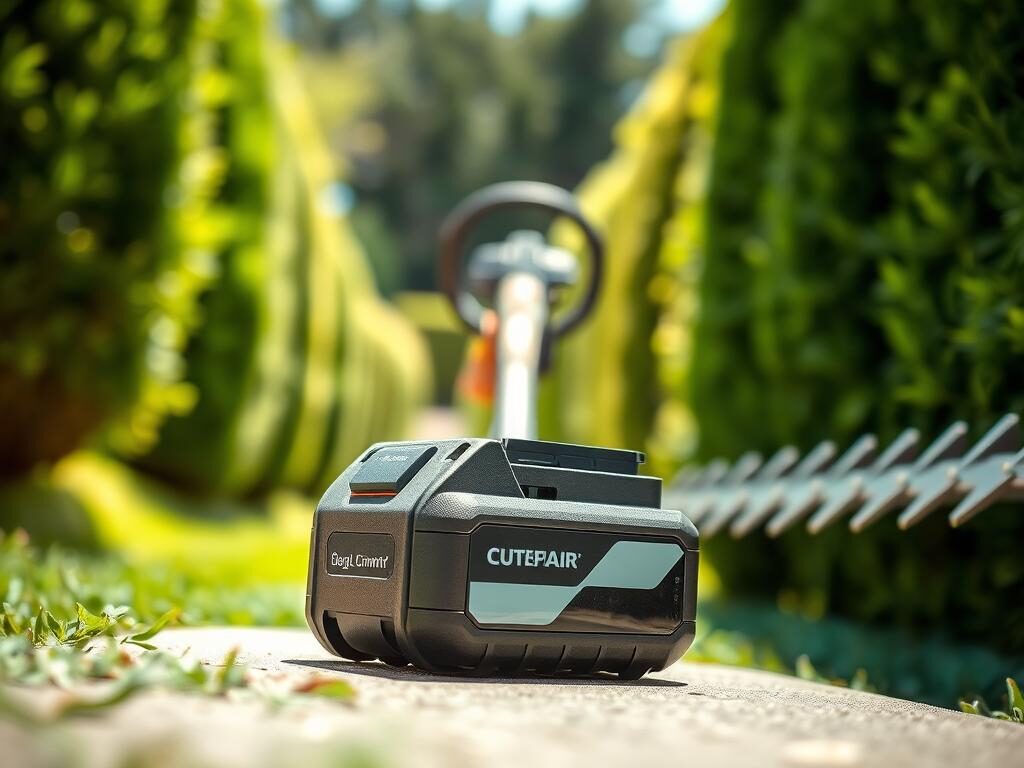
Voltage and real-world performance
20V-class units handle light shaping and small foundation shrubs with ease. They’re lighter and less tiring for detail work.
Higher platforms (40V–60V) keep cutters from bogging on woody stems. It’s not just volts—the motor design and blade sharpness make a big difference.
Run time you can expect
Small yards and quick touch-ups: one 20V pack usually does the job.
One privacy hedge line or larger borders: plan on a 40V+ pack or two batteries so you don’t stop mid-run.
Charge realities and why a second battery helps
If your charger needs an hour or more, your pace becomes “trim, wait, trim.” A spare battery is the single best upgrade—especially if it fits other power tools you own.
- Stretch battery life: keep a steady pace, avoid forcing thick branches, and let blade speed do the work.
- Smart buy: prioritize platform compatibility over raw capacity.
Best overall hedge trimmer for 2026: Husqvarna Hedge Master 320iHD60
When performance matters most, the Husqvarna 320iHD60 earns its spot at the top. I picked it because it pairs a fast ~3,800 cuts/min rate with a smooth feel—low vibration keeps long runs comfortable and control tight.
Why it stands out
Power and cut quality: the 36V platform and sharp blade deliver clean cutting on fresh growth and thin woody stems. Boost mode gives a quick surge for stubborn spots, though it trims battery life.
Usability features I value
The triple-handle design is smart: swapping grips is quicker than rotating the whole tool, so lines stay straight. A reverse button helps free jams without fuss. The included sweeper attachment pushes clippings off faces so you can see what you’re shaping.
Tradeoffs to know
At ~12.8 lb with battery, this trimmer is heavier than most. It’s well balanced, but you feel the weight on long or overhead jobs. It’s also priced like a premium model—worth it if you have big work, less so for light, occasional use.
- Best for: homeowners with large runs or who want top-tier cutting performance.
- Step down if: you need a lighter, lower-cost model for small shrubs and quick touch-ups.
Best value hedge trimmer: Worx Nitro 40V WG286</h2>
For budget-minded yards, the Worx Nitro 40V WG286 hits a rare sweet spot between light weight and real cutting speed.
I like the dual 20V battery setup. Two smaller packs add to a 40V system while keeping the tool near ~8.2 lb. That makes overhead work and long runs easier on your arms.
Power-to-weight advantage with dual 20V battery design
The WG286 runs about ~3,400 cuts/min and feels sprightly for its price. In plain terms: it slices through leafy growth and routine shaping without feeling sluggish.
Why it’s the value pick: power-to-weight balance is excellent for the money. The five-position rotating handle helps with clean vertical and horizontal passes.
Where it struggles: thicker stems and lighter-duty build quality
It will slow on thicker, woody stems—so plan to take smaller bites or pre-cut with loppers. The housing leans thin plastic and grips aren’t as rubberized as premium models.
For normal yard use, this is fine. For dense, woody walls, consider a stronger 56V+ model instead.
- Best for: budget buyers, Worx battery users, routine trimming and shaping.
- Not ideal for: heavy woody growth or commercial use.
| Model | Cut Speed (cuts/min) | Voltage | Weight |
|---|---|---|---|
| Worx Nitro WG286 | ~3,400 | 40V (2×20V) | ~8.2 lb |
| Husqvarna 320iHD60 | ~3,800 | 36V | ~12.8 lb |
| EGO HT2601 | ~3,600 | 56V | ~11.5 lb |
Best cutting capacity for thicker branches: EGO Power+ HT2601
The EGO Power+ HT2601 turns thick, woody messes into manageable, straight walls. Its 56V platform and long 26-inch bar give real cutting capacity—I saw clean slices on stems up to ~1.2 inches without the motor lugging.
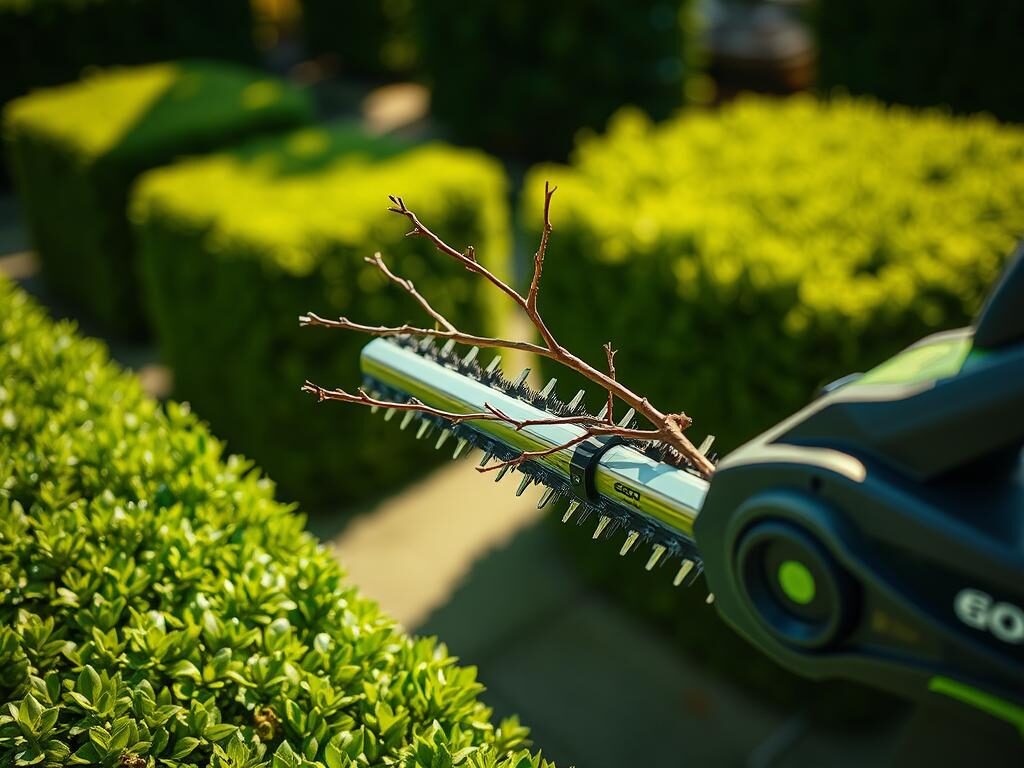
Why the long bar and 56V matter
A 26-inch bar means fewer passes and less ladder hopping. The extra length smooths wall shaping and speeds the job. At ~3,400 cuts/min the blade keeps momentum and chops through woody interior growth more predictably.
Handle rotation for cleaner lines
The five-position rotating handle is one of those small design wins. I cut horizontally across tops, then flip the grip to run straight down sides—no wrist twist, neater faces.
What to watch: weight on long runs
It’s about ~9.8 lb loaded. That weight gives stability but you feel it after long sessions. If you have lots of big shrubs, this trimmer’s power is worth it. For tiny yards, a lighter trimmer is easier to grab and go.
Best for large jobs: Greenworks Pro Ultrapower 60V 26-Inch Hedge Trimmer
For big, stubborn walls of green, the Greenworks Pro Ultrapower feels like a steady workhorse rather than a sprinting tool. It’s a smart pick when torque and long-run capability beat instant blade speed.
Slow-but-powerful profile for woodier interior growth
Performance: the 26-inch bar and roughly ~3,200 cuts/min give steady momentum. It takes on about ~1.1-inch branches without lugging, so interior woody growth gets chewed through once it’s up to speed.
Handle rotation limitations and how that affects comfort
The handle rotates to three positions—fewer than many competitors. That can force awkward body angles on long wall work.
Workaround: break the task into shorter passes and reset your stance often. Despite the modest rotation, the tool’s balance helps reduce fatigue.
Startup and speed feel compared with faster-cutting models
It has a slightly longer wind-up to full speed. That means you don’t get instant snap, but you get consistent cutting torque for thick stems.
Who it’s for: homeowners with long runs and dense growth who want sensible value and real power over top-end RPMs.
- Key strengths: strong torque, 26″ bar, priced competitively for large jobs.
- Watch for: limited handle rotation and slower spin-up vs. faster models.
| Model | Bar length | Cuts/min | Max branch | Weight (with battery) |
|---|---|---|---|---|
| Greenworks Pro Ultrapower 60V | 26 in | ~3,200 | ~1.1 in | ~10.1 lb |
| Husqvarna 320iHD60 | — | ~3,800 | ~1.0–1.2 in | ~12.8 lb |
| EGO HT2601 | 26 in | ~3,600 | ~1.2 in | ~11.5 lb |
Best pole hedge trimmer for tall hedges: Craftsman V20
Getting at the top of an 8-foot privacy wall is all about safe reach and control. The Craftsman V20 solves that by putting the cutter where your hands can’t safely go—so you stay on the ground and in control.
Reach and head-angle adjustability for shaping tall shrubs safely
The pole runs about 6 feet 8 inches, so it reaches the top of most 8-foot shrubs without a ladder. The head adjusts to five angles, which makes topping and side cuts straightforward.
Angle positions mean you can cut flat tops and clean sides without guessing. That saves time and gives neater lines.
Performance limitations of a smaller 20V motor
It uses a 20V motor with an 18-inch blade and about ~2,800 cuts/min. Power is fine for leafy growth but slows on woody stems.
Expect slower performance when you hit thicker material—take smaller passes or pre-cut with saws.
Run time vs. charge time considerations for stop-and-go trimming
The battery gives a decent run, but the charge time is long. If you trim in short bursts, one pack stretches; if you want to finish in one go, plan a spare battery or extra charge time.
- Practical tip: fixed pole length is great for tall jobs but can be awkward on low hedges.
- Safety: keep stable footing, never overreach, and watch for sudden branch pulls.
| Model | Voltage | Blade | Length | Weight | Cuts/min |
|---|---|---|---|---|---|
| Craftsman V20 Pole | 20V | 18 in | 6 ft 8 in | ~10.9 lb | ~2,800 |
| Worx Nitro WG286 | 40V (2×20V) | — | — | ~8.2 lb | ~3,400 |
| EGO HT2601 | 56V | 26 in | — | ~11.5 lb | ~3,600 |
Best mini trimmer for detail work: Worx 20V Power Share Shrubbery Trimmer
For fine shaping and close-in work, a compact unit often outperforms big machines. I reach for a mini when I want control, not raw sweep.
The Worx 20V Power Share weighs about 2.4 lb with battery. It has an 8-inch trimming blade and runs near ~1,100 cuts/min. That size and weight make it ideal for potted plants, narrow walkways, and small shrubs.
Where a compact blade beats a full-size bar
Use the mini around tight corners and delicate ornamentals. It lets you tidy edges without shearing off too much. Think of it as precision work instead of brute force.
Swappable blades for precision and light shearing
This kit includes a 4-inch shear blade you swap in for finish work. The trimming blade is best for short hedges and light shaping. The shear blade handles thin shoots and gives cleaner, closer cuts.
- Best use: detail shaping, trimming small shrubs, and spot touch-ups.
- Not for: long walls or thick, woody branches—it’s light-duty by design.
- Practical tip: keep a charged spare battery if you want continuous detail work.
If you want one as a second tool for neat yards, this tiny cordless trimmer is a real secret weapon. To see one option and current listings, consider this short link to buy the mini unit: Worx 20V Power Share mini.
Gas vs. battery hedge trimmer: which power tools make sense for your yard
Your yard size and plant toughness usually decide whether petrol or battery is best.
When petrol-style power makes sense: large properties with long runs and dense, woody growth benefit from sustained output. Petrol units deliver continuous torque for hours and chew through thick branches without a long rest. If you’re cutting all day, a gas option can save time—just expect more maintenance and higher noise.
Why cordless wins for most homeowners
Cordless models beat gas for ease: low noise, less vibration, no fumes, and instant starts. I reach for batteries for quick shaping and regular upkeep. They’re lighter and simple—click a pack in and go.
Corded electric and practical tradeoffs
Corded models give steady power but the cord limits reach and can be a trip hazard around long runs. They work well for small yards near an outlet. For long borders, the cord becomes a real annoyance.
Not a job for a chainsaw
A chainsaw rips and scars thin exterior stems, making messy, uneven faces. If branches are too thick for your trimmer, cut them out first with a chainsaw or loppers, then finish shaping with a proper tool for clean lines.
- Quick decision help: all-day heavy cutting → petrol; routine shaping and neighbor-friendly noise → cordless.
- Workflow tip: remove large branches first, then shape with the trimmer for neat results.
What to look for when buying hedge trimmers
Picking the right tool starts with matching what you actually cut, not the prettiest spec sheet. Below I walk through the key points that decide whether a tool finishes the job or gets stuck mid-run.
Cutting capacity and tooth spacing
Cutting capacity is about tooth spacing vs. branch thickness. Narrow spacing is great for fresh growth. Wider teeth cut larger branches without jamming.
Match capacity to your plants: thin stems → close teeth; woody branches → wider spacing and higher torque.
Blade length and bar control
Full-size tools usually use ~24–26-inch bars. A longer bar speeds work across long runs.
But longer length can reduce control on tight edges. Pick a blade length that fits the shape work you do.
Blade speed and real trimming time
Blade speed (cuts per minute) typically sits near ~3,200–3,800 cpm. Faster blades cut with fewer passes, which saves time and energy.
That doesn’t replace capacity—speed helps on leafy growth but torque wins on thick branches.
Weight, balance, and comfort
Typical weight ranges from ~8–13 lb with battery. Weight matters most on overhead cuts and long walls.
Good balance reduces fatigue; heavy-but-well-balanced beats light-and-awkward every time.
Noise, handle design, and safety
Noise is a practical concern—lower sound keeps neighbors happier on weekend jobs.
Handle systems (rotating grips vs. multi-grip) change control for vertical and horizontal passes—try the motion before buying.
Safety features I insist on: two-stage starts, robust guards, and tip protectors for work near a wall or the ground.
| Feature | Why it matters | Practical tip |
|---|---|---|
| Cutting capacity (tooth spacing) | Prevents jams on branches | Match teeth to your thickest branch |
| Blade / Bar length | Covers more hedge per pass | Choose 24–26″ for long runs; shorter for tight control |
| Blade speed (cpm) | Reduces passes and trimming time | Faster ≈ fewer passes; torque needed for woodier stems |
| Weight & balance | Controls fatigue during overhead work | Prefer balanced tools even if slightly heavier |
Run time, charge time, and battery platform decisions that save money long-term
Nothing wastes an afternoon faster than a dead battery mid-run. Plan for the real-world pace of trimming: stop-and-go cuts, jam clearing, and brief rests all cut into quoted run time.
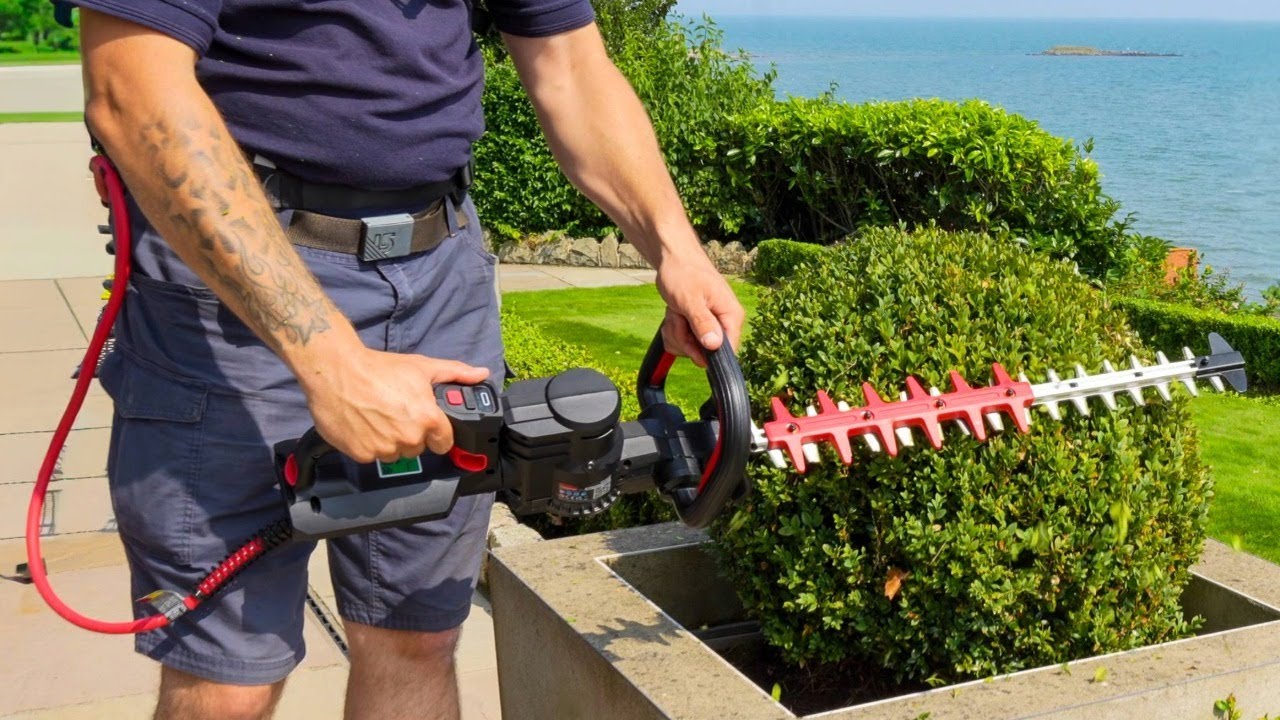
How to estimate the run time you actually need
Measure your hedge line length and note density. A short, leafy border takes a fraction of the time a dense privacy row needs.
Quick cleanup vs. full reshape matters. For reshapes, multiply expected time by 1.5–2 to allow for thicker cuts and breaks.
Fast chargers, spare batteries, and planning around charge time
Charge time can be the real bottleneck. If a charger needs an hour, a second pack is basically “buy your afternoon back.”
Practical move: get at least one spare and, if available, a fast charger. That reduces downtime and keeps progress steady.
Why battery ecosystems matter if you own other cordless tools
Buying into a platform costs more up front but saves later. One battery that fits a mower, blower, and saw means fewer packs to buy.
Make sure voltage compatibility, charger speed, and available tool models match what you’ll use next year.
- Checklist before you buy: voltage compatibility, charger wattage/charge time, spare battery cost, and whether the platform supports other DIY tools you’ll use.
- Rule of thumb: small yards → single pack may suffice; long walls or heavy reshapes → two packs plus fast charger.
How to trim hedges cleanly without wrecking the shape
A clean, consistent line starts with a plan and a steady hand—here’s the routine I use. First, set the top plane so you can follow a flat reference as you work down the sides.
Technique for flat tops and straight sides
Make a shallow pass across the top to establish the line. Then work the sides with horizontal strokes to remove bulk.
Use vertical passes for tight corners and when you need a sharp edge from street view. Horizontal passes smooth long runs faster.
How to avoid jams and uneven cuts on woody stems
Don’t force the blade into thick branches. If the motor bogs, stop and pre-cut large branches with loppers.
Keep the bar moving—short, steady strokes clear clippings and reduce jams. Uneven cuts usually mean a dull blade, excessive pressure, or wrong cutting capacity for the stems; sharpen or switch tools if needed.
Using tip protectors when trimming near fences, walls, and the ground
Fit a tip protector when you work close to a wall or low fence. It prevents nicking the blade on hidden bricks or rocks and keeps the finish neat.
My quick checklist:
- Top first, then sides—follow the plane.
- Light passes—sneak up on the final line.
- Pre-cut thick branches to avoid jams.
- Use tip protectors near walls and the ground to protect the blade and the surface.
Safety, seasonal timing, and blade maintenance for better performance
Start every trim with a checklist—safety gear, a nest scan, and a dead battery out of the tool. I keep this routine short and strict. It saves time and keeps the job calm.
Safety gear checklist: eye protection, gloves, and covered skin
Eye protection is non-negotiable. Add grippy gloves and long sleeves so clippings don’t turn into scratches. I also wear boots and hearing protection when noise gets high.
Before you cut: check for bird nests during March–August and beyond
Make sure the plants are clear of nests—March through August is prime breeding season, but I still check year-round. Disturbing wildlife is avoidable with one quick sweep.
How to sharpen blades with a flat file
Remove the battery first. Clean debris, then file each tooth with long, one-direction strokes. Keep the same stroke count per tooth—small, steady passes work best.
Cleaning and storage habits that extend blade life and reduce rust
Wipe sap and grit after use, dry the blade, and store with a cover. Sharp blades cut cleaner, jam less, and make battery life stretch—good maintenance pays off.
| Task | Why it matters | Quick action |
|---|---|---|
| Eye & hand protection | Prevents injuries from flying debris | Wear glasses and grippy gloves |
| Nest check | Protects wildlife and avoids delays | Scan March–August; check always |
| Sharpening | Keeps cuts clean and reduces jams | Battery out; flat file; even strokes |
Want more on selecting the right gear? See a tested list of the best hedge trimmers to match the tools you already own.
Final Thoughts On Best Hedge Trimmers
To finish: buy the tool you’ll actually pick up. Best overall: Husqvarna. Best value: Worx Nitro. Thick-branch power: EGO. Big-job budget: Greenworks. Tall hedges belong to the Craftsman pole, and detail work is where the Worx mini shines.
Prioritize cutting capacity for your thickest stems, comfortable handling for long sessions, and enough battery life to finish the job without a mid-yard recharge. Cordless models give most U.S. homeowners the best mix of low noise, instant starts, and usable performance.
Think platform, not just price—one shared pack can cut future tool costs. In short: match features to your routine, and you’ll get better results by trimming often, not by one heroic day a year.