Kate Donovan
A useful backup has to last through the outage—and have a practical way to recharge.
At 2 a.m., the refrigerator stops humming, the router goes dark, and a phone is nearly empty. A gas generator cannot safely run inside an apartment: its exhaust can cause fatal carbon monoxide poisoning. A portable power station avoids exhaust, but its battery is finite.
The sensible choice starts with essential devices, not every appliance in the home. Check their power demands, allow for a refrigerator’s startup surge, and compare expected runtime with the likely outage length. Size and weight matter, too, especially if recharging means carrying the station to another location.
Match the station to the load list


This is a research-only comparison, not hands-on testing. It draws on published manufacturer specifications, manuals, and retailer listings; advertised runtime and refrigerator compatibility were not independently verified.
-
Power for the load
Rated battery capacity was weighed against AC output, startup-surge capability, and the likely losses from running appliances through an inverter. A refrigerator’s starting demand can exceed its normal running wattage.
-
Fit for an apartment
Weight, outlet options, indoor operation, and access to wall or solar recharging matter alongside capacity. Solar usefulness depends on whether the apartment has a safe, permitted place for a panel.
-
Check the exact listing
Before purchase, confirm the stated capacity and output for the selected model, which cables or panels are included, the current price, and the warranty’s duration and coverage. Bundles and seller terms can differ.
Anker SOLIX C1000 Gen 2: Refrigerator and connectivity backup
01
Fast recharging and strong buyer feedback for apartment backup.
The C1000 Gen 2 suits an apartment household that wants one battery for a refrigerator, router, phones, and essential lighting. Its 1,024Wh capacity makes it a practical overnight bridge for modest loads, rather than a substitute for days of household electricity.
- 2,000W rated output and 3,000W peak provide headroom for many refrigerator startup surges; the appliance’s actual requirements still need checking.
- Anker advertises 10 ports for keeping connectivity and small essentials powered alongside a refrigerator.
- Anker claims a 49-minute full recharge at 1,600W with HyperFlash enabled in its app, useful when grid power returns briefly.
- A 1,024Wh battery will not run a refrigerator for multiple days without recharging. Actual runtime depends on the fridge’s duty cycle and conversion losses.
- High-draw appliances can drain the battery quickly, even when their wattage falls below the output limit.
- Warranty coverage and any conditions tied to the current listing need confirmation before purchase.
The C1000 Gen 2 is the most balanced first pick here for keeping cold food and basic communications going through a shorter outage. Capacity is the constraint: available AC energy will be less than the stated 1,024Wh, so refrigerator runtime should be estimated from actual consumption rather than the output rating. Keep it stored where it can be reached during an outage, and verify the seller’s warranty terms before ordering.
EcoFlow DELTA 3 Classic: Solar recharging when space allows
Includes a 220W solar panel for flexible recharging.
At roughly $700, this bundle pairs a 1,024Wh DELTA 3 Classic with one 220W solar panel. It suits an apartment where the panel can be placed outdoors in reliable sun and outlet charging remains the primary plan. Solar may extend runtime during a long outage, but it cannot be counted on to replenish the battery each day. For mains-first alternatives, compare the DELTA 2 and AC180 for backup power.
- The listed bundle includes a 220W-rated panel, avoiding a separate panel purchase.
- A 1,024Wh battery and 1,800W rated output offer room for more than phone charging, provided appliance demands stay within the station’s limits.
- cons
- unit_summary
- invalid
- Shade, window placement, or balcony rules can make the panel of little practical use.
- Wall-charge time is not established by the supplied listing; check it before comparing recharge speed.
- The station and panel may arrive separately, so confirm that the specific offer includes both.
BLUETTI Elite 30 V2: Keep the router and lights on
Lightweight, lower-cost power for smaller outage essentials.
The BLUETTI Elite 30 V2 is a 288Wh station for an apartment outage plan centered on staying connected and keeping a room lit. It weighs a listed 9.4 pounds and costs about $280, making it a practical candidate for a closet shelf rather than a dedicated backup-power corner.
For a rough runtime check, a 10W router, 10W LED lamp, and device drawing 10W while charging total 30W. That load might run for about 6–8 hours, allowing for conversion losses; actual draw and runtime will vary. Charging a phone intermittently instead of continuously would leave more energy for the router and light.
- Listed 9.4-pound weight is manageable for apartment storage.
- 288Wh capacity can cover several hours of low-draw essentials.
- 600W rated output accommodates more than USB-only devices.
- Limited battery capacity makes extended outages harder to cover without recharging.
- 600W rated output restricts appliance choices and combined loads.
- Nine listed outlets do not mean nine demanding devices can run together.
EBL 2400W: Backup for larger apartment loads
Large battery and high output at around $500.
The EBL Acc2400 is a battery station for apartments where backup needs extend beyond phones, lighting, and internet. Its published specifications list a 1,843.2Wh LiFePO4 battery and 2,400W output; the distinction between those numbers matters when planning what it can run and for how long.
- The stated 2,400W output accommodates more demanding appliances than an essentials-only station, provided their startup draw is within its limits.
- A 1,843.2Wh battery offers substantial stored energy for extended low-power loads.
- The listed price is around $500, though the current configuration and price need checking.
- 2,400W is an output rating, not a runtime promise: at a continuous 500W, the battery holds under four hours of energy before conversion losses.
- Published evidence here does not establish the unit’s weight, footprint, or recharge time. Confirm all three before committing apartment storage space or relying on a short charging window.
- Verify warranty coverage, the claim process, and available support against the seller’s current documentation.
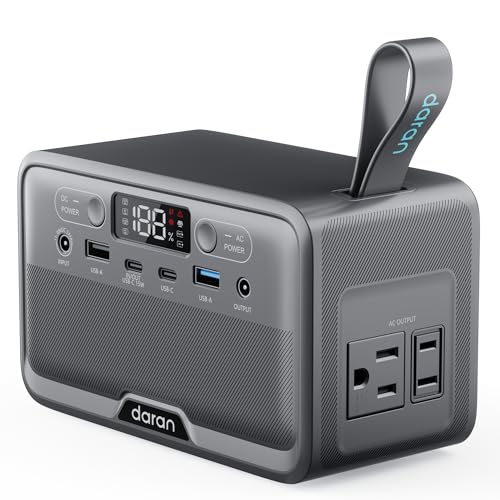
Daran: Pocket-sized power for phones and lights
- 89.6Wh capacity is suited to charging phones and tablets or running a small light.
- USB charging, including PD, and AC outlets accommodate different small-device chargers.
- At a listed 2.54 pounds, it is easy to store in an apartment.
- The 100W continuous output rules out most refrigerator-scale loads; the 200W peak rating does not change that.
- Actual runtime will be shorter than capacity divided by device wattage, especially when using AC.
Estimate runtime before choosing a station
-
Add the loads that will run together
A refrigerator drawing 100W while running, a 15W router, and a 10W light total 125W. The refrigerator may cycle on and off, so this continuous-load example is a conservative starting point. For a broader load list, see how to choose the right power station for an outage.
-
Multiply by the hours needed
At 125W for six hours, those devices would require 750Wh of delivered energy. A station labeled 750Wh would not be enough when powering them through AC outlets.
-
Allow for conversion losses
The inverter uses some battery energy to produce AC power, and the station may draw power while operating. Using 80% of rated capacity as an illustrative planning allowance, a 1,024Wh station supplies about 819Wh: 819 ÷ 125 is roughly 6.5 hours. Actual runtime depends on the devices and station.
-
Check the startup surge separately
A refrigerator compressor can briefly demand far more than its running wattage. Its startup demand must fit the station’s surge capability, while the combined running load must fit its continuous output rating; the retailer’s watt-hour figure answers neither question.
-
Keep output and endurance distinct
A 2,000W output rating means a station can support a sufficiently large load, not that it can sustain one for hours. At a continuous 1,500W draw, the same illustrative 819Wh of usable energy lasts about 33 minutes.
Place and charge the station safely
A power station can run indoors, but its placement and charging method must follow the specific model’s manual. Check required ventilation clearance, permitted charging temperatures, and instructions for AC, vehicle, or solar input. Keep the unit dry, away from heat sources, and out of enclosed cabinets unless the manual permits that location. For a fuller setup checklist, see how to use a power station indoors safely.
Apartment rules matter as much as the equipment manual. Do not block exits or shared corridors with a station, charging cable, or panel. Check the lease and building or fire rules before putting equipment on a balcony, attaching a panel to a railing, or running a cable through a door or window. Never connect a station to an exterior electrical panel or apartment wiring unless the manufacturer’s instructions allow it and a qualified electrician has arranged an approved connection.
Solar charging requires direct sunlight for useful output. A shaded balcony or panel behind glass may produce much less than a bundle’s advertised panel rating. Before buying for outage use, confirm that the exact station accepts the intended panel and that the building permits a sunny, secure place for it.
Do not assume a station provides uninterrupted power while charging. Pass-through and backup switching vary by model; check the manual for supported operation and transfer time, then confirm compatibility with the equipment manufacturer. For medically necessary devices, arrange a dedicated, approved backup plan rather than relying on an unverified station.
For a documented refrigerator-and-router load, the Anker SOLIX C1000 Gen 2 is the strongest starting point; for lights, phones, and a router, the smaller BLUETTI Elite 30 V2 avoids paying for unused capacity. Choose the EcoFlow DELTA 3 Classic bundle only if its panel has a permitted, reliably sunny place to work.
Size the purchase to the calculated runtime, then confirm the exact bundle contents and return terms. Reserve a ventilated storage and charging spot, follow the manual’s guidance on storing the station between outages, and check its charge periodically.