Kate Donovan
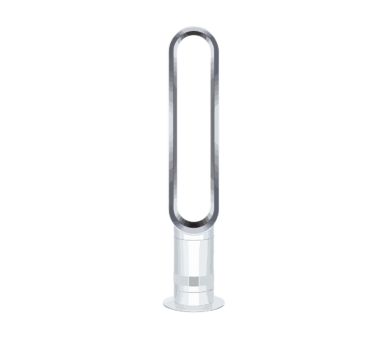
The fur on the sofa is only the part of the allergy problem that can be seen.
A dog shakes beside the sofa, and dander and dried saliva proteins can drift well beyond the hair left behind. These microscopic allergens also settle into rugs, curtains, and upholstery, then return to the air when disturbed. In an open-plan home, they may travel between living, dining, and kitchen areas.
A square-foot rating is therefore only a starting point. Real performance depends on airflow, room shape, placement, tolerable fan noise, and regular filter care. A purifier can reduce airborne particles, but it cannot capture allergens already embedded in furnishings or eliminate allergic reactions. Vacuuming, washing pet bedding, and following medical guidance remain essential.
The best fit at a glance


Advertised room sizes are manufacturer claims, often based on fewer air changes per hour. Allergy-prone rooms generally benefit from faster, repeated filtration, so choosing extra capacity can be worthwhile.
Each purifier was judged on documented performance rather than headline room coverage. Current manuals and manufacturer materials were checked where available, with greater weight given to clearly stated airflow or CADR.
Fine-particle filtration mattered most for airborne dander. A washable, removable, or otherwise practical pre-filter earned extra credit for catching fur and extending the main filter’s useful life.
Coverage claims were translated into meaningful air changes per hour; larger advertised areas often assume only one change hourly. Noise at useful fan speeds also mattered, since quiet, continuous operation is more effective than occasional high-speed use.
Replacement-filter availability, clear maintenance reminders, straightforward controls, scheduling, and dependable app features were considered. These details make it easier to keep filtration running day after day.
Carbon layers may help with litter-box or pet odors, but carbon quantity and contact time vary widely. For allergy relief, credible airflow and fine-particle capture remain the stronger priorities.
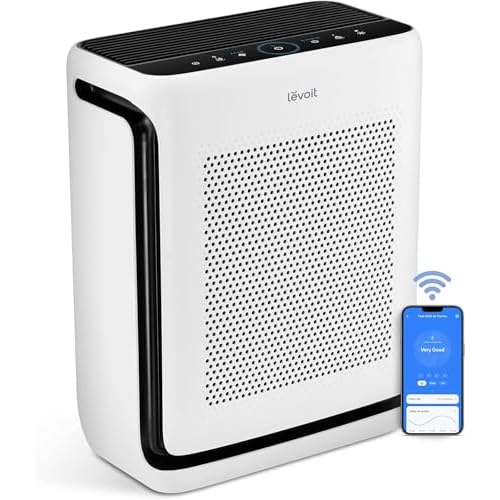
LEVOIT Vital 200S-P: the balanced large-room pick
01
Top choice for quiet, connected pet-allergy protection
The Vital 200S-P suits substantial bedrooms and everyday living rooms shared with shedding pets. Its combination of automatic operation, connected controls, and a pet-friendly pre-filter makes it an approachable step up from compact purifiers without moving into bulky commercial-style equipment.
- Air-quality monitoring enables automatic fan adjustment
- Washable pre-filter helps manage fur and lint
- Strong airflow for bedrooms and moderate living areas
- Sleep mode keeps nighttime noise restrained
- Replacement filters are widely available
- Full scheduling and history favor the VeSync app
- Replacement filters add an ongoing expense
- Headline coverage does not imply frequent air changes
Quick take Its sensor-led automation and practical pre-filter reduce day-to-day fuss. For allergy control, room sizing should be based on several air changes per hour rather than the maximum coverage claim.
The Vital 200S-P offers the most even balance of airflow, quiet operation, filtration, and automation in this group. It is a convincing fit for substantial bedrooms and moderate living rooms, provided filters are replaced on schedule and the room is sized for a meaningful air-change rate.
MOOKA PR1: an affordable move beyond desktop purifiers
Best for affordable coverage with a washable filter
The MOOKA PR1 is aimed at pet households needing more reach than a compact bedside unit without moving into premium pricing. Its upright, large-room design makes the most sense in bedrooms, offices, or modest open living areas, where pet dander and drifting hair are recurring concerns. Manufacturer coverage figures should be treated as maximums rather than guaranteed whole-room performance.
- H13 HEPA media targets dander, pollen, smoke, and other particles around 0.3 microns
- Washable pre-filter helps capture pet hair before it loads the main filter
- PM2.5 display provides an immediate air-quality reading
- Straightforward onboard controls require no app setup
- Published coverage lacks strong independent airflow or CADR documentation
- Automation is more basic than premium sensor-driven models
- Higher fan settings may be intrusive in quiet rooms
- Replacement-filter availability can be less predictable than with major brands
KJ03: smart scheduling for sprawling open layouts
Maximum stated coverage with quiet sleep operation
The KJ03 targets open-plan living zones where app scheduling and a 3,000-square-foot headline matter. With eight-foot ceilings, that area holds 24,000 cubic feet: each air change per hour requires roughly 400 CFM, while 4–5 ACH needs 1,600–2,000 CFM. No CADR is provided, so the allergy-relevant rate cannot be verified.
| Claimed area | 3,000 sq ft |
| 1 ACH need | ~400 CFM |
| 4 ACH need | ~1,600 CFM |
| CADR | Not disclosed |
| Sleep sound | 15 dB claimed |
| Connectivity | Smart Wi-Fi |
| Filter design | Double-sided, washable |
- Scheduling suits long daily runs
- Washable filter surfaces ease upkeep
- Broad claimed room coverage
- Published airflow is missing
- Full-speed sound and dimensions are unclear
- Replacement-filter supply needs checking
uahpet UJHQ03A: washable first defense against fur
Pet-focused filtration at a lower upfront price
The uahpet is aimed at homes where shedding and lint can quickly coat a purifier’s first layer. Its removable, washable pre-filter may keep larger debris away from the H13 HEPA filter, potentially helping the main filter work effectively for longer—but the HEPA filter will still require periodic replacement.
The claimed 2,100-square-foot reach is difficult to judge without a published CADR or air-change rate. It appears better suited to a moderately large room than a sprawling open plan where rapid allergen reduction is expected. The “pet” branding alone does not establish superior dander capture.
- Washable layer catches visible fur and lint
- H13 HEPA main filtration
- Built-in air-quality monitor
- Compact footprint for its claimed coverage
- No published CADR for checking airflow
- Large-room claim lacks an air-change rate
- Main filter remains a consumable
- Replacement-filter supply appears model-specific
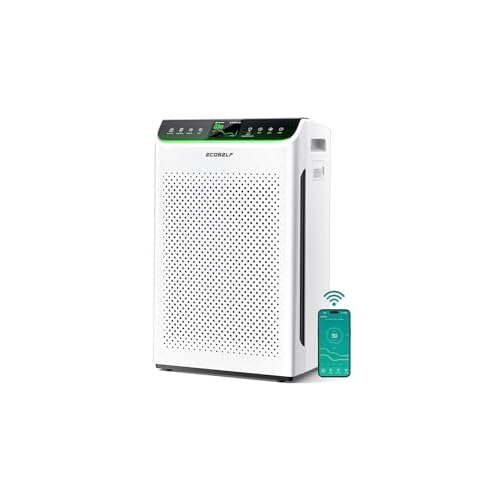
HAP610WF: app monitoring for broad living areas
Largest stated coverage with app-based monitoring
The HAP610WF is positioned for open living rooms and loft-like spaces, with a stated coverage ceiling of 3,850 square feet. Its app, AQI display, and trend graph suit households that want visible air-quality tracking alongside pet-focused filtration.
| Claimed coverage | Up to 3,850 ft² |
| CADR | Not disclosed |
| Modes | Auto, Eco, Pet, Sleep |
| Monitoring | AQI + trend graph |
| Controls | Smart app |
| Upkeep | Washable filter |
| Dimensions | Not listed |
- Broader stated coverage than the KJ03
- App-based monitoring and mode control
- Washable filtration may simplify routine upkeep
- CADR remains undisclosed, as with the KJ03
- Large body requires meaningful floor space
- Noise at useful fan speeds is undocumented
- Divided rooms can weaken circulation
Convert coverage claims into useful airflow
-
Calculate the room’s volume
Multiply floor area by ceiling height. A 500-square-foot room with nine-foot ceilings contains 4,500 cubic feet—not the 4,000 assumed by an eight-foot-height estimate.
-
Choose a realistic air-change target
For stronger pet-allergen control, roughly four to five air changes per hour (ACH) is a practical goal. One ACH may underpin impressive coverage claims, but it cleans the room too slowly for continual dander and dust.
-
Convert volume into required airflow
Use: cubic feet × target ACH ÷ 60 = required CFM. That 4,500-cubic-foot room needs about 300 CFM for four ACH or 375 CFM for five.
-
Compare against verified performance
Look for independently verified smoke CADR, which is commonly reported in CFM, or another credible airflow rating. Use the purifier’s performance at a speed that can run comfortably for hours—not merely its loudest setting.
-
Allow for real-room losses
Walls, alcoves, tall ceilings, bulky furniture, and open doorways weaken mixing or increase the volume being treated. Separate rooms generally need separate purifiers; an open doorway does not create even filtration.
A large coverage number means little without its test conditions and ACH assumption. Verified smoke CADR or credible airflow should lead the decision, followed by ceiling height, layout, and tolerable fan speed. When data is missing, sizing claims deserve extra caution.
What matters beyond room-size claims
-
Particle capture and sealing
Pet allergens ride on fine dust, so effective media matters only when room air cannot bypass it.
Look forA fine-particle mechanical filter and gasketed, sealed airflow pathAvoidVague “multi-stage” filtration with visible gaps around the filter -
Measured airflow and noise
CADR indicates cleaning speed; high-mode noise determines whether that airflow remains usable.
Look forCredible smoke CADR plus noise figures for medium and high speedsAvoidHuge coverage claims based on one slow air change per hour -
Routine upkeep
An accessible pre-filter simplifies fur removal, while readily available main filters keep the purifier serviceable.
Look forTool-free pre-filter access and consistently stocked replacement filtersAvoidProprietary filters with uncertain availability -
Running costs and automation
Wattage matters for continuous operation. PM2.5 sensors can adjust fan speed, though they do not measure pet allergens directly.
Look forPublished power draw and responsive particle sensingAvoidSensors or apps that add controls without useful readings
-
Start where exposure is highest
Place the purifier in the room most shared by the pet and allergy sufferer.
-
Leave airflow unobstructed
Keep intakes clear of walls, curtains, and furniture, with open space above the exhaust.
-
Run it continuously
Use the highest speed that remains tolerable; a quieter setting that stays on beats intermittent maximum power.
-
Maintain the pre-filter
Vacuum or wash it as directed before fur and dust restrict airflow.
-
Control allergens beyond the air
HEPA-vacuum regularly, wash bedding, wipe surfaces, manage humidity, and keep pets outside the bedroom when symptoms persist.
Before buying, confirm that verified airflow, operating sound, and replacement-filter availability are practical long term.
The LEVOIT Vital 200S-P is the strongest all-around choice for documented performance and everyday usability. The MOOKA PR1 suits tighter budgets, while the uahpet is appealing for heavy shedding. For very large spaces, consider the KJ03 or HAP610WF only after confirming CADR and replacement-filter supply.